

 Two Poems about Samuel Beckett
A Stabbing Leads to a Life-Long Relationship
In the A.M. of January 7, 1938
Samuel Beckett was stabbed by someone
demanding money, & Beckett saying No
on a Paris street
The knife missed the heart
from the waddings of his coat
though it could have killed him.
A young woman named
Suzanne Deschevaux-Dumesnil
returning from a concert
came to Sam’s distress
wrapped him in a friend’s overcoat
& swathed together a pillow ’neath
his head, then called for an ambulance
He was taken to a hospital
where he was saved
James Joyce loaned him a reading lamp
during his stay in the hospital
& Beckett corrected the proofs of Murphy.
He was discharged from l’ hôpital on 1-23-38
And as for Suzanne the Savior— she was a
skilled pianist & teacher of piano
& for the next decades served Sam,
while fiercely protecting herself from the public
as she “moved into his life.”
In World War II living with Suzanne
Sam stored dynamite
for the Resistance
in his house.
& so it went on unto the always.
The Premiere of Waiting for Godot in 1953
Late in the year his mate Suzanne brought
“Waiting for Godot”
to producer Roger Blin, who read it w/ care
in part because Tristan Tzara
had praised Beckett—
Blin soon agreed to put it on.
There was trouble locating a Theater
Finally Blin secured the tiny
Théâtre de Babylone
for an opening January 5, 1953
Godot had only four actors, in low-income
costumery, so they could wear their street clothes
& Blin wouldn’t need much illumination
beyond a spotlight & a barren tree on the stage.
Beckett attended rehearsals & work-ups,
hesitating at first to butt[but?] in
because of his lack of experience
in Theater[theater?]
but soon he began to shape the acting
& stage-business (and always thereafter)
& took great charge of Godot
& all future plays
& scripts.
The opening was shouted to the rafters
& suddenly, at 47, Sam was famous.
The Bunker Hill Plateau
In 1960 I became a Pacifist
[shd this whole poem be flush left underneath the first line?]
and for years took part in
Peace Walks against the Bomb
and also an attempt in 1961
to swim out into New London Harbor
to board a Polaris Nuclear Sub
outfitted with nuclear missiles each
programmed to blam! into a specific
site in Russia.
In a jail afterwards I wrote my first book
Poem from Jail. When I had a family I
altered my Pacifism, declaring I would
use violence to protect my wife & daughter,
but nowhere else.
Now, in the increasing uber-authoritarian
Trump era, I’m again pondering what
condition would cause me to support
violence against a political evil.
I call it the “Bunker Hill Plateau,”
and think I know what that is— what
level of Evil would have to arise
to become like the Battle of Bunker Hill
in 1795 to cause me to take up
arms against an over-authoritarian evil.
I can feel the B.H. Plateau shivering
on the horizon, how it might foster taking
up arms with the passion of WW 2.
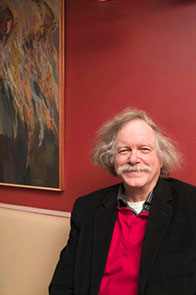
ED SANDERS is a poet and performer whose roots go back to the Beats. During the Vietnam War, he was active in the antiwar movement and founded the Peace Eye Bookstore on Manhattan’s Lower East Side. He was also a founding member of the satiric folk-rock band The Fugs as well as the Yippies. He helped found the underground newspaper The East Village Other. He is the author of numerous works of poetry and nonfiction, including Thirsting for Peace in a Raging Century: Selected Poems, 1961-85, winner of an American Book Award; 1968: A History in Verse; the nonfiction work The Family, about Charles Manson and his dystopic communal family; and a multi-volume history of America in investigative poetry. He lives in Woodstock, N.Y.
foto credit if needed